Advance Publication
Accepted: January 24, 2025
Published online: November 5, 2025
Contents>> Vol. 14, No. 3
The House Is Not a Home for the Buddha: The Tai Zawti Dhamma Altar in Myanmar
Olivia Porter*
*Centre of Buddhist Studies, SOAS University of London, 10 Thornhaugh St, London WC1H 0XG, United Kingdom of Great Britain and Northern Ireland
e-mail: op11[at]soas.ac.uk
 https://orcid.org/0000-0003-2305-0118
DOI: 10.20495/seas.25010
Browse “Advance online publication” version
This paper investigates the 350-year-old Tai Zawti Theravada tradition and its distinct lay practice of keeping Buddhist texts, rather than Buddha images, on a dhamma altar inside the home. Drawing on Zawti-authored texts as well as interviews with Tai Zawti monks and laity, it examines the rationale for the altar, its function and position in the home, the nature of the texts kept on the altar, and how this marker of distinction is blurred by new challenges. While the Zawti tradition offers important insights into the nature of pre-reform Burmese Buddhism and premodern Theravada more broadly, by focusing on the nature of the lik long texts kept on the Zawti dhamma altar, the paper demonstrates how the Tai Zawti are firmly situated within the wider Tai cultural context.
Keywords: Theravada Buddhism, Tai (Shan), Tai Buddhism, Tai Literature, Tai Zawti, lik long
1 Introduction
Images of the Buddha are ubiquitous throughout Theravada Southeast Asia and certainly among the Tai (Shan) communities of Myanmar. The Tai constitute the ethnic majority of Shan State, the largest of the country’s seven states, where upwards of 81 percent of the population self-identify as Buddhists (The Republic of the Union of Myanmar, Department of Population 2016, 3). Buddha images seem to be everywhere one turns in the State, from the walls of teashops to the dashboards of vehicles. It came as a surprise to me, then, when I visited the home of a Tai elder in rural southern Shan State and noticed that he did not have any images of the Buddha in his home. An altar stood in the center of his main room, complete with the offerings of fresh flowers and small cups of water that one would expect to find on a typical Tai Buddhist altar. But the offerings were not made to an image of the Buddha in either picture or statue form; instead, they were made to texts housed on the altar. This was a dhamma altar, dedicated to Buddhist lik long, or traditional Tai poetic texts composed in verse and meter.
The elder I visited was a member of the Tai Zawti Theravada Buddhist tradition (hereafter Tai Zawti or Zawti). The Zawti trace their origins to Varajoti, the monk who founded the tradition in the late-seventeenth century.1) Today, they comprise a very small monastic community and a sparse but widespread group of dedicated lay followers who live throughout Myanmar and in Dehong Prefecture of Yunnan, China. Little is known about the Zawti tradition outside the group itself. Despite sharing an ethnic identity and cultural practices with the Tai, the Zawti are not well known among the wider Tai community; among the Burmese, they are practically invisible. One finds only enigmatic and at times erroneous mentions of the Zawti in Western scholarship since the nineteenth century, first by missionaries to Burma and then by colonial scholars, anthropologists, and political scientists of the region (Porter 2023). This relative obscurity is related to Zawti interactions with authority over the course of their near 350-year history.
The early Zawti monastic community clashed several times with authority over divergent views towards merit-making and the treatment of pagodas. When Venerable Nandamāla, the abbot who succeeded Varajoti after his death in 1744, preached that building a monastery from silver and gold is akin to the gathering of timber (Khing Kān Kham Sāng Sām 1997, 14), a regional governor expelled the Zawti monks from Upper Burma. This marked the beginning of the Zawti migration into the Shan States, where the monks moved around frequently during the mid-eighteenth century, establishing small lay communities wherever they settled.2) The Zawti monastic and lay community thus became closely associated with the Tai ethnic group and this association remains representative of the contemporary tradition.
Even after their retreat from Upper Burma, the Zawti were targeted by several Royal Orders during the reign of both King Hsinbyushin (r. 1763–76) and King Bodawhpaya (r. 1782–1819). In instituting his Thudhamma reforms, which cemented the Theravada hegemony that has shaped modern Burmese monasticism, King Bodawhpaya purged monastic sects that did not conform to the regulations (Schober 2008; 2011). As part of the purge, in 1783 Bodawhpaya targeted the Zawti laity specifically, ordering that any detained Zawti follower must publicly renounce their faith to be freed (Than Tun 1986, 25). On September 8, 1783, a punishment was announced for royal guards who had allowed members of the Zawti sect in the Sinbyugyun area of central Burma to escape after being detained: the silver that the guards had accepted as bribes was to be melted and poured down their throats (Than Tun 1986, 31). Bodawhpaya’s targeting of Zawti laity rather than the monks, who were the subject of the reform measures, suggests that he saw the Zawti monastic influence on the laity as a threat to his authority over his subjects.
During this period, the Zawti monastic community settled in Loi Lek, in Tse Phāng (pinyin: Zhēfàng) in present-day Mangshi, China, where they remained from 1777–1861, on the peripheries of both Burmese and Chinese authority.3) The Zawti monks had little communication with outsiders during this period and staying on the China side of the border allowed them to bypass Bodawhpaya’s Thudhamma reforms. This meant that the Zawti retained some features of monastic practice that were lost to the Thudhamma reform of the eighteenth century and to numerous subsequent reforms of the Burmese Sangha. The Zawti tradition therefore offers us important insights into the nature of pre-reform Burmese Buddhism and premodern Theravada more broadly.4)
The Zawti community took advantage of the obscurity that isolation afforded them, continuing to migrate throughout the Tai peripheries until the twentieth century. In the 1960s, the Zawti established their monastic headquarters at Paññālaṅkāra Monastery in Kachin State, where it remains today.5) In the 1980s, the Zawti officially integrated into the Burmese Sangha when they were absorbed into the Thudhamma gaing during Ne Win’s Sangha reforms.6) Yet even after this absorption, the Zawti maintained their distinctive monastic and lay practices, and their own distinct identity as members of the Tai Zawti tradition (Porter 2023, 90–99).
While the Zawti remained relatively unknown to those outside of their community, they were—and remain—active in disseminating traditional Tai poetic literature called lik long. Thus, among the wider Tai community, scholar monks and lay ritual practitioners called zare, who compose and recite lik long literature in various religious and cultural settings, are likely to have some awareness of the Tai Zawti even if they have never met a Zawti monk or lay person. This is because Paññālaṅkāra Monastery (the Tai Zawti headquarters in Kachin State), is renowned among the Tai scholarly community for its production of highly skilled zares, who undertake rigorous lik long training while ordained as novices there. Remember that it was these lik long texts, rather than images of the Buddha, that were kept on the home altar of the Zawti elder in southern Shan State.
When I entered the Zawti elder’s home, I had been immediately struck by the absence of Buddha images on an altar that would not look out of place in almost any Tai home. As an outsider to the tradition, this to me was an obvious marker of distinction that set Zawti lay practice apart from mainstream Tai Theravada practice, and it became a topic that I brought up with many of the Zawti lay people that I met while conducting my doctoral research. This paper draws on that ethnographic fieldwork, conducted with Zawti communities in Myanmar from 2019–20, follow-up interviews conducted with Zawti lay people, and textual analysis of Zawti authored sources I acquired during fieldwork. I examine the unique Zawti lay practice of paying reverence to texts rather than Buddha images inside the home and how this practice acts as a shibboleth, a marker of difference recognized by those both inside and outside of the community.7) In doing so, I aim to situate the Zawti within the broader context of Tai Theravada as well as to highlight the diversity of Tai Theravada and its place in the development of contemporary Theravada in Southeast Asia. I highlight how Zawti lay practice represents an expression of lay austerity that predates the lay reform movements that were characterized by a renewed fervor and commitment to lay morality and ethics and that emerged throughout Buddhist communities in Southeast Asia in response to the pressures of colonialism.
2 The Dhamma Altar/Shelf
According to Zawti-authored texts and the numerous Zawti lay people I have spoken with, the Zawti laity have traditionally kept dhamma shelves—altars that house Buddhist texts rather than Buddha images—inside the home.8) Several terms are used to refer to these altars, including: kheng trā (ၶဵင်ႇတြႃး or dhamma shelf, but with the sense of “dhamma shrine” or “dhamma altar”) and toek trā (တိူၵ်ႈတြႃး or dhamma depository/box). Kheng phrā (ၶဵင်ႇၽြႃး or Buddha altar/shelf) is the term used by the wider Tai community to describe home altars that house Buddha images. While the Zawti traditionally do not keep Buddha images on their altars, some within the community still refer to the altar as a kheng phrā, since the texts on the altar are religious in nature and relate to the Buddha and his teachings.
Within both the Zawti and the wider Tai Buddhist communities, there is also the tradition of keeping a kyong phrā (ၵျွင်းၽြႃး or Buddha shrine/temple) just outside the home as either an attached or unattached structure. One Zawti informant, a young zare from northern Shan State, remarked that keeping a kyong phrā outside the home is an old Tai tradition. One or two people can fit inside the structure, which houses Buddha images and Buddhist texts, and it is used for worship and meditation. In the book Long Khoe Zawti le Phing Phāsā, which explores the customs and traditions of the Zawti laity, lay elder Khing Kān Kham Sāng Sām (1997, 74) notes that the laity are allowed to keep Buddha images in a kyong phrā, which must be kept “on the corner of your veranda.” Yet, while kyong phrā structures are permissible, they are not common among the Zawti laity.9) The young zare from northern Shan State described how usually only wealthy Zawti families keep kyong phrā because they are costly to build. Instead, he said, most Zawti families have a dhamma altar inside the home and visit the local kyong tai (ၵျွင်းတႆး or Tai temple) to worship Buddha images.10)
In the Zawti context, kyong tai refers specifically to the small village temples where both Buddha images and texts are housed. In the absence of Zawti monks, all of whom reside in the monastic headquarters in Kachin State, the Zawti laity congregate at these kyong tai temples to participate in community rituals led by zares.11) The geography of Zawti kyong tai throughout Myanmar and across the border in the Dehong region in China is extensive and reflects the history of the Zawti monks’ migration and the subsequent network of lay settlements. In the past, each Zawti village or cluster of villages had its own kyong tai as the place where the laity went to worship Buddha images. This accessibility of Buddha images at the kyong tai made their presence in the home less necessary for the Zawti laity.
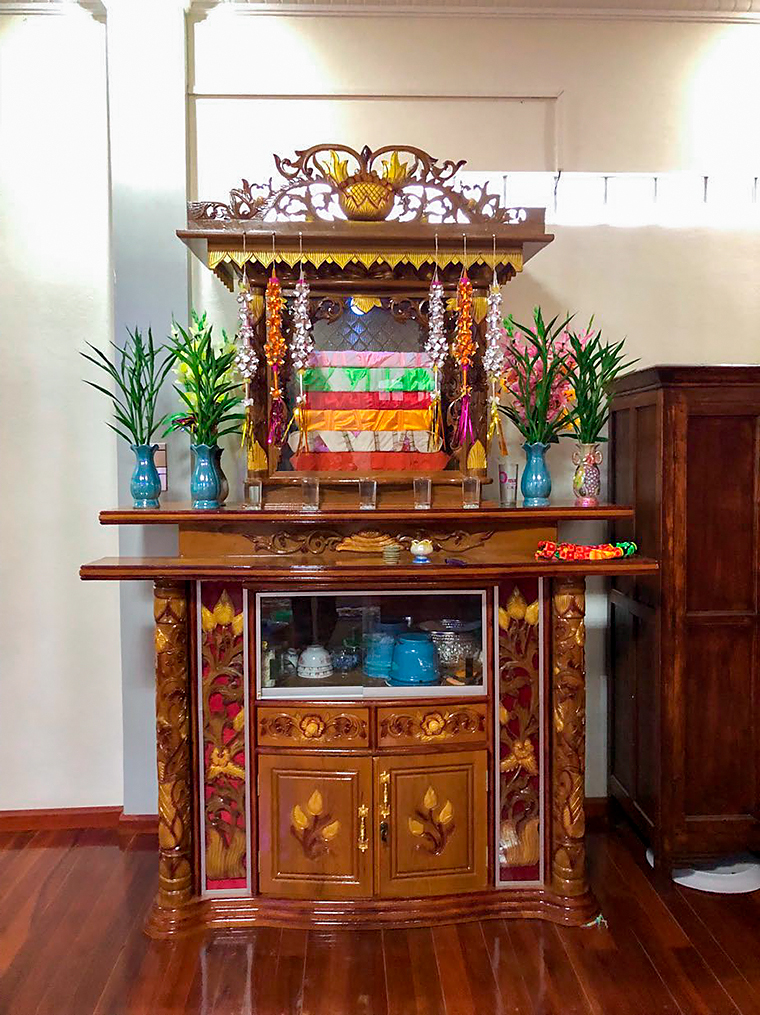
Fig. 1 Image of the Dhamma Altar inside the Home of a Zawti Elder in Southern Shan State (taken by the author on December 6, 2019)
Now, let us return to the Zawti dhamma altar within the home. Khing Kān Kham Sāng Sām (1997, 74) describes the dhamma shelf (he uses the term ၶဵင်ႇတြႃး kheng trā) as “the place where you pay respect” and specifies that “only books on the dhamma, dhamma scrolls or dhamma treatise can be kept on the dhamma shelf, nothing else, even Buddha statues.” It is also prohibited to keep images of deities and teachers as well as traditional Tai hangings used for protection or luck on the dhamma shelf (Khing Kān Kham Sāng Sām 1997, 74). This is a response to the very common practice across Southeast Asia of keeping photos or statues of deities and venerated monks or ascetics on the home altar, along with Buddha images. The prohibition against Tai hangings used for protection or luck reflects the Zawti rejection of superstitious beliefs associated with pre-Buddhist Tai customs, which are commonplace among the wider Tai community.12) For the Zawti, only dhamma texts must be kept on the dhamma altar because it is the dhamma that is the object of worship; the Buddha and his qualities are evoked through the dhamma texts. This reflects the Zawti’s centering of and strict adherence to the dhamma texts, examined in detail below.
The Zawti are not aniconistic, the tradition is not absent of Buddha images, and it is not considered inappropriate to create and worship such images. Why, then, are Buddha images prohibited from home altars? The concern here is the location inside the house—a place of mundane worldly affairs, family arguments and various other types of false speech (in Pali, musāvādā), sexual intercourse, and countless other potential breeches of the five precepts. In other words, the house is a profane, not sacred, space and is therefore not an appropriate place to keep Buddha images. In his fieldwork among Tai communities in Ruili, China in the mid- 2000s, Kojima Takahiro (2012, 408) observed that every house in TL Village (pseudonym) had a shelf for Buddhist texts, flowers, and paintings of the Buddha, but there were no Buddha statues. He was told that Buddha statues should be kept in the monastery, since inappropriate deeds such as sexual intercourse are carried out in laypeople’s homes. While the understanding of the home as a profane place is shared, one key difference between the Zawti communities I met in Myanmar and Kojima’s informants in China is that while those in Myanmar prohibit photos, paintings, and statues, those on the China side of the border prohibit only three-dimensional statues.
A Zawti elder in southern Shan State noted another reason why one’s house is not an appropriate place for Buddha images. He explained that the floor of a traditional Tai house (a wooden structure built on stilts) shakes when the residents walk through the rooms. It would be disrespectful and improper to cause Buddha images to shake in such a way, and therefore it is considered inappropriate to keep Buddha images inside the home.13) As modern homes have more structural integrity and the shaking is no longer a concern, some Zawti lay people now keep Buddha images inside their homes. Others continue to observe the practice as per tradition regardless of the structural integrity of their home.
The Zawti interpretation of the Tipiṭaka, or Pali Canon (the authoritative texts of Theravada Buddhism), is also pertinent to the practice of keeping a dhamma shelf. One senior Zawti zare from northern Shan State explained that in the Tipiṭaka there are no examples of the Buddha sleeping inside the home of a lay person once he attained Buddhahood. If he travelled, he would sleep in a monastery, a temple, or under a tree. As there is no textual example of the Buddha sleeping inside a home and the Zawti monastic and lay community aim to follow the path of the Buddha during his lifetime, it is not suitable to keep images of the Buddha inside the home.
There are two interpretive components at play here. First is the strict textual adherence of the Zawti: as there no textual reference of the Buddha staying inside a lay person’s home, no Buddha images should be kept inside a Zawti person’s home. The lack of textual reference also explains the absence of any other objects of veneration on the Zawti dhamma altar. Other monks, teachers, and superstitious practices are not detailed in the canonical material and as such, they also have no place on the Zawti dhamma altar. This layer of interpretation distinguishes the Zawti tradition. Indeed, Zawti monasticism is markedly austere compared to mainstream Tai and Burmese monasticism due to its strict interpretation of and adherence to the 227 rules of the Pāṭimokkha, as recorded in the Vinaya (Porter 2023, 160–184). This strict adherence is also reflected in Zawti lay interpretation of the five precepts (pañcasīla), which manifests in many rules and regulations that are far stricter than those of mainstream Theravada lay practice (Porter 2023, 243–280). Thus, distinctive Zawti monastic and lay practices are often rooted in a close reading of the canonical material.
Variations in textual interpretation that manifest in noticeable differences in practice are usually associated with monastic conduct. Within the Burmese Sangha, for example, interpretation of canonical material varies somewhat among the nine gaing, which manifests in different monastic conduct and comportment, with the Shwegyin group known for their strict adherence to the Vinaya and the Thudhamma known to be more lax. To see variation rooted in the interpretation of canonical material among lay practice, however, is unusual.
The second interpretive component relates to the Zawti world view. For the Zawti, the Buddha image is not just a visual or symbolic representation of the power associated with the Buddha, but also a representation of the historical figure of the Buddha and the moral behavior of the Buddha as described in the Tipiṭaka. Therefore, the Buddha image must behave as the Buddha behaved. This coalescence of the Buddha image and the Buddha himself is recognized by the veneration and devotional services offered to Buddha images in other Buddhist contexts. Kyaw and Crosby (2013, 271), for example, assert that the daily and elaborate face-washing and teeth-cleaning rituals performed for the Mahāmuni Buddha image in Mandalay can be interpreted as treating the image of the Buddha as a living double of the Buddha.
The young Zawti zare from northern Shan State noted that when the laity worship the texts placed on the dhamma altar, they have the Buddha in their minds and therefore it is not necessary to keep a physical image of the Buddha. This corresponds with the mental processes involved in Buddha worship detailed in the teachings of the Abhidhamma. When one worships the Buddha, the Buddha is the object of the worshipper’s mind, whether he is present, dead, represented by an image or a statue, or illusory. The worshipper’s mind may be conscious of the historical Buddha, the living Buddha represented through images or statues, or the qualities of the Buddha. The Abhidhamma teaches that the mental object of worship can be from the past, present, or future and it does not need to be physically present. The mental object of worship is not confined to temporal or spatial boundaries, and therefore, one can worship the Buddha anywhere, even if there is no physical image of the Buddha present (Kyaw and Crosby 2013, 264–265).
Here we come to realize that while the absence of Buddha images in a traditional Zawti home may appear to signify that such images play a less important role in Zawti worship than in the worship of other Theravada Buddhists, on the contrary, this tradition reflects a great respect for Buddha images and careful attention to canonical detail. The Buddha image is treated as an embodiment of the Buddha as he is depicted in the canonical literature—as a renouncer of lay life who should be kept pure from it. The dhamma texts, on the other hand, are the embodiment of the Buddha’s teachings and the Zawti practice of placing them on the home altar aligns with the centrality of texts to the Zawti tradition. At the same time, the Zawti lay practice of keeping a dhamma altar identifies the laity with the Zawti monastic lineage and its distinctive practices, which are rooted in strict interpretation of the texts. This contrasts with the wider Tai and Burmese Buddhist communities, who identify simply as “Buddhist,” rather than with any monastic gaing (such as Thudhamma or Shwegin) associated with the monasteries they may visit or monks they may venerate.
In examining the Zawti dhamma shelf and the reasons why Buddha images are absent from it, a picture emerges of Zawti lay practice as an example of lay austerity rooted in a strict adherence to the canonical literature. Such lay austerity is representative of the Buddhist lay reform movements of the nineteenth century, which emerged throughout Southeast Asia in response to the pressures of colonialism. Yet, the Zawti, and their position outside the mainstream, predate colonialism in Myanmar. The Zawti tradition, then, offers us a window into the nature of pre-reform Theravada and practices that have been preserved amidst various reforms (Porter 2023, 278–280). Indeed, the Zawti may be one of the most austere Buddhist lay communities in Southeast Asia.
2.1 The Positioning and Function of the Zawti Dhamma Altar
Let us turn to the positioning and function of the Zawti dhamma altar within the home. The Zawti elder in southern Shan State said that he prayed in front of the dhamma altar daily and presented offerings to it on specific days. (His offerings of flowers and small glasses of water are visible in the photo of Fig. 1.) This accords with Khing Kān Kham Sāng Sām (1997, 74), who notes that “you [the Zawti] should keep three pots of flowers at the front of the altar, and you should change the flowers four times a month [on uposatha days] and on the wan sin days [uposatha days during vassa].”14) Another informant, who grew up with her Zawti grandparents in northern Shan State, described how her grandparents prayed at their dhamma altar each morning and evening and offered flowers, incense, and candles.15)
The function of the traditional Zawti dhamma altar as the site of daily religious activity within the home is in many ways the same as that of a Buddha altar in a traditional (non-Zawti) Tai home, where Buddhist texts and Buddha images are displayed as objects of worship. In her examination of a Tai Buddhist community in northern Thailand, Nancy Eberhardt (2006, 105–197) details how the household Buddha altar plays a central part in the daily routines of Tai people: a woman of the household spoons freshly cooked rice and curries into small offering cups and takes the food and fresh glasses of water to the Buddha altar first thing in the morning; she then sits on the floor with her legs folded to one side and raises each cup to the level of her head and recites a short prayer before placing them on the altar. Eberhardt notes that this two-minute offering and prayer establishes the household as one that accepts the teachings and preeminence of the Buddha while simultaneously laying claim to the power and protection implied by this status. In the evening, lay people light candles and incense to place on the altar and pray again. Evening prayers seek protection from illness and malevolent forces that come out at night (Eberhardt 2006, 105–197). The ritual function of the dhamma altar in the daily religious activity of the Zawti laity is the same as that of a traditional Tai altar that houses images of the Buddha. Both types of altars are used to pay homage to the Buddha and the dhamma and are where the laity perform religious offerings within their homes. Eberhardt’s description of the function of the Buddha altar and the daily rituals associated with it is framed in terms of worship, but also in terms of power and protection, specifically protection from illness and malevolent forces. The only difference is that for the Zawti, it is the teachings of the Buddha (which are composed in the texts housed in the dhamma altar), rather than physical images of the Buddha, that are imbued with this protection.
The position of the Zawti dhamma altar in the house also reflects its function as the site of religious worship inside the home and as a repository of sacred objects imbued with a power that offers protection. Traditional Tai homes are divided into: 1) the na hern (the front part), where guests are received; 2) the kaang hern (the middle part), a shared space for the family where cooking and socializing takes place; and 3) the nai hern (the inner part), where family members sleep. In Tai homes, the keng phra (Buddha shrine) is kept in the kaang hern (the middle part of the house) and faces east, the direction associated with the Buddha’s enlightenment. Although separated from the kaang hern, the nai hern, or sleeping quarters, orient east-west to align with the Buddha shrine (Oranratmanee 2018, 112). The Buddha shrine therefore is integral to the spatial arrangement of traditional Tai homes, which are divided into sacred and profane spaces that center around the Buddha shrine. The same holds for the dhamma altar in a Tai Zawti home. The Zawti elder in southern Shan State also kept his dhamma shelf in the kaang hern, the main room where families socialize and host guests.
Neither the traditional Tai Buddha altar nor the Zawti dhamma shelf are ever kept in the sleeping quarters of the house. The bedroom is associated with the ritual pollution of sexual intercourse, and it is therefore not an appropriate place for housing images or texts that are imbued with the symbolic power of the Buddha. On the placement of dhamma texts in the sleeping quarters, one informant whose father and entire paternal family was Zawti remarked that Zawti women should never sleep in the presence of a lik long text or a Buddha image. This is noteworthy in that the object of the prohibition is the female sex rather than exposure to sexual activity.
3 The Nature of the Dhamma Texts
The texts housed in Zawti dhamma altar are lik long texts. Lik long is a genre that covers topics ranging from local history and folklore to astrology and traditional medicine. Lik long of a religious nature is called lik trā langkā long, or “texts of great dhamma (trā) poetry” and it is these texts that are housed in the Zawti dhamma altar. The oral recitation of lik trā langkā long at community events plays a central role in disseminating Buddhism among the Tai, especially among those who are not literate. Thus, the Zawti and the wider Shan Theravada Buddhist community share a mutual appreciation of and common interest in lik long literature and the Zawti are known for their mastery of lik long among the Tai monastic community.
Lik long is recited by lay ritual practitioners called zares. The Tai term zare (ၸရေး) is derived from the Burmese cāre (စာရေး or clerk) and was originally used to refer to the secretary, or clerk, of the saopha, the Tai princely rulers who ruled the Tai polities known as the Shan States during the British colonial period until the twentieth century (Crosby and Khur-Yearn 2010, 2). Among the older generations in northern Shan State and across the border in Dehong, China, these practitioners are called ho lu (ႁေႃးလူႇ or leader of offerings). One senior zare from Muse (in northern Shan State) explained to me that in the border area, where there is less exposure to the Burmese language, fewer loan words have been adopted. The term zare, with its Burmese origin, is therefore not familiar to them, and they exclusively use the Tai term ho lu. He commented that although he preferred the term ho lu, he was now accustomed to zare, which is widely used throughout Shan State.
Zares compose, transcribe, and recite lik long. The texts are composed in a combination of Tai, Burmese, and Pali, and written in multiple Tai scripts, which correlate to the period they were composed and the background of the composer. Zawti zares from communities now located in Dehong, China, traditionally used the tho ngong script (in Shan, ထူဝ်ႇငူင်း or the “bean sprout” script) and their compositions tend to contain some Chinese loan words. Among the Zawti living on the Myanmar side of the border, the lik tai long (great Tai or central Tai script) and the modern Tai script are used, which tends to contain more Burmese loan words (Crosby and Khur-Yearn 2010, 2–3; Khur-Yearn 2012, 46–49). The Zawti zares learn to compose Tai lik long in the modern Tai script while ordained at the Zawti monastic headquarters in Kachin State.
Unlike the wider Tai community, the Zawti only keep lik long texts that are derived from the Tipiṭaka on their home altar. Popular texts include the paṭiccasamuppāda (dependent origination), sotāpanna (stream-entry), and the six ārammaṇas (the six sense objects). In contrast, the wider Tai community engages with lik long material that is not strictly based on the Canon, reciting such texts at religious events and keeping them on traditional home altars along with images of the Buddha. According to Khur-Yearn (2012, 40), while some Tai lik long compositions (of a religious nature) are based on Pali commentaries, the majority of Tai lik long contains non-canonical texts and he proposes that such compositions may in fact be unique to Tai Buddhism. This assertion is based on the popularity of apocryphal Jātakas among the Tai. The Jātakas are the stories found in the Khuddaka Nikaya of the Sutta Piṭaka that detail the meritorious acts of the Buddha in his previous lives (which led to his rebirth as a Buddha). Key Buddhist concepts such as karma (in Pali, kamma) and merit (in Pali, puñña) are taught to Buddhist lay people through Jātaka recitations. While there are Tai lik long compositions of canonical Jātakas, apocryphal Jātakas are popular among the wider Tai community, and are composed by zares and recited to lay audiences in the same way as canonical Jātakas (Khur-Yearn 2012, 40).16)
One of the tasks of the zare as a lay poet and textual expert is to transcribe lik long. The zare makes copies of existing lik long manuscripts that can be stored in the home, at the temple, or in a monastery. Skilled zares are also able to compose their own lik long material, meaning that they create new poetic texts that conform to the literary conventions of lik long poetry. My zare informant from northern Shan State remarked that some contemporary zare also compose Jātakas for the purpose of pure entertainment rather than any moral teaching. But he emphasized that the Zawti would never keep such compositions on their home dhamma altar. This contrasts with mainstream Tai Buddhists, who do not distinguish between canonical and apocryphal Jātakas and may keep both types on their home altar.
Khur-Yearn (2012, 30) identifies six classical poets associated with the composition of the most famous Tai lik long texts: Zao Thammatinna (1541–1640), Zao Kang Suea (1787–1881), Zao Kawli (1847–1910), Nang Kham Ku (1853–1918), Zao Amat Long (1854–1905), and Zao Naw Kham (1856–95) (Khur-Yearn 2012, 30). Their compositions, the earliest of which are attributed to the sixteenth century, continue to be copied, transcribed, and disseminated among contemporary Tai Buddhist communities, including the Tai Zawti (Khur-Yearn 2012, 30). The lik long texts kept on the Zawti dhamma altar are often copies of texts composed by these six poets. Although none of the six, as far as I am aware, belonged to the Zawti tradition, the Zawti community holds them in extremely high regard and considers their compositions authoritative.17)
In keeping lik long texts composed and transcribed by non-Zawti zares on their home altar, the Zawti laity demonstrates that it is the content of the text, which must be canonical or from the accepted commentaries, that is important, rather than the specific affiliation of the zare. The shared lik long tradition and admiration for the six classical poets and their compositions situates the Zawti within the wider Tai Buddhist context: despite their own monastic lineage and distinct practices, the Zawti share a cultural identity with their wider Tai kin.
Indeed, even during prolonged periods of geographic and social isolation from the eighteenth century into the twentieth century, the Zawi retained a key line of communication with the wider Tai community, that of religious texts (lik long). But while lik long unifies the Zawti with the wider Tai community, it also obscures the Zawti as a distinct tradition. Whether or not this obfuscation was advantageous to the Zawti, particularly during periods when the Zawti were targeted for their distinctive practices, is not clear. The ways in which this shared admiration for Tai lik long relates to Tai Zawti identity, and how the Zawti are understood by the wider Tai community are questions for future research.
3.1 The Question of Consecration
A Buddha image only becomes an object of worship, whether in the home, temple, or monastery, when it has been consecrated in an abhiseka, or Buddhābhiseka, ritual ceremony (in Burmese, အနေကဇာ).18) The Zawti perform the ceremony when consecrating Buddha images to be housed in Zawti temples (kyong tai) and at the Zawti monastery. In contrast, lik long texts kept on the home dhamma altar are not consecrated.19) Why do lik long texts, which are canonical in nature and are venerated by the Zawti in the same way as a Buddha image, not require consecration? I propose that this is because there are no examples of textual consecration in the Tipiṭaka.
According to the Pali commentaries, there are three types of Buddha relics: pieces of the Buddha’s body, objects used by the Buddha, and objects that remind one of the Buddha (Gombrich 1966, 25). Lik long texts are not considered relics (in Pali, dhatu, or “essence”). Buddha images, namely statues, remind one of the Buddha and their status is enhanced by placing relics of the Buddha’s body inside them (such as a hair or a tooth). Richard Gombrich (1966, 25) describes how Buddhaghosa, the great fifth-century commentator of the Pali Canon, identified the tradition of enhancing a Buddha image with a relic of the Buddha’s body as the rationale for worshipping a Buddha image at all. Following Buddhaghosa’s line of argument, since a Buddha relic cannot be placed inside a text, it cannot be the object of a consecration ritual or any associated enhancement rituals. Therefore, despite being an object of worship, it is not necessary to consecrate the lik long text before placing it on the Zawti dhamma altar.
Although lik long texts kept on the Zawti home dhamma altar are not consecrated, they are treated with the same reverence, and function in the same way (in everyday religious ritual), as a Buddha image kept on a non-Zawti home altar. This is because the texts represent the teaching of the Buddha and, as the young zare from northern Shan State remarked, the Zawti have the Buddha in their minds when they worship and present offerings to the texts at the dhamma altar. In his exploration of Buddha image consecration in Northern Thailand, Swearer (1995, 263–280) details how the omnipresence of the Buddha image in virtually all ritual settings provides a common referent to the Buddha as the focus. The Buddha image acts as a reminder of the Buddha and re-presents his life, teachings, powers of lifetimes of moral perfections (pārami), and extraordinary states of consciousness (ñāna). For the Zawti, the physical presence of the lik long dhamma texts evokes this same re-presentation of the Buddha.
4 A Marker of Distinction, Obscured by New Challenges
I have explored the Zawti custom of keeping lik long dhamma texts rather than Buddha images on the home altar, how the Zawti dhamma altar functions in the religious lives of Zawti lay people, and the nature of the lik long texts kept on the altar. I now want to turn attention to how this practice is understood as a marker of distinction both by the Zawti laity and by outsiders to the tradition. I shall also explore how and why some Zawti lay people have begun to keep Buddha images inside their home and some of the external pressures that have impacted such changes.
Both the Zawti and outsiders to the Zawti tradition acknowledge the lack of Buddha images in the home as a marker of distinction. When I interviewed a group of Zawti khings (male community elders) in Laihka in November 2019, they confirmed that the Zawti practice differed from that of mainstream Tai and Burmese Buddhists. Images of the Buddha on the home altar are so common, one khing recalled, that when a non-Zawti neighbor came to visit him, he noticed the absence and asked him if he was a Christian (Porter 2023, 226). Although this khing recounted the story as a humorous anecdote, comments and enquiries from outsiders are not always friendly.
My young zare informant from northern Shan State was born in a village close to the Zawti monastery in Kachin State. He explained that when his family lived near the monastery, they did not keep Buddha images in their home. But, when they moved to a city in northern Shan State, they broke from tradition and kept Buddha images on their altar so as not to stand out. He noted that he would prefer to keep only texts on the family dhamma altar, but if they did, then non-Zawti visitors would ask too many questions. He added that he prefers very simple Buddha statues over ornate images of the Buddha wearing a crown or plated in gold. Thus, the Zawti are conscious of their “outsider” status, even among the Tai community. This case also demonstrates the willingness of the Zawti laity to adapt to their cultural surroundings, something that is perhaps reflective of their experience of being singled out and suppressed by outsider authorities. This adaptation helps us understand how the Tai Zawti community have remained relatively unknown for so long.
The young zare’s experience is not uncommon among Zawti who, after moving outside their community, become aware that their religious practices differ from the mainstream. Indeed, moving from a traditional Zawti village setting to urban environments is an important factor in the decision of contemporary Zawti lay persons to keep Buddha images on their dhamma altar in addition to lik long texts. One middle-aged woman from a Zawti village in Kachin State remarked that her family never kept Buddha images in the home, and that it was only after she left her community that she realized that this was not the norm. When she settled in Yangon and married a Bamar Burmese man, she decided to keep a small Buddha image in her home.
Examples thus far have only considered the voluntary migration of families moving for work opportunities or other personal reasons. But, as we know, the Zawti have been forced to migrate frequently over the centuries due to conflict, war, and falling out of favor with authority. Political instability and conflict have been part of Zawti history since its inception, with Shan State in a state of armed conflict for the past several decades.20) Since 2021, Northern Shan State, where many Zawti lay communities live, has been the site of intense fighting between the Myanmar military and multiple armed ethnic groups; this and repeated air bombardments by the Myanmar military have forced tens of thousands to flee.21) In the past, the Zawti have self-imposed social and geographic isolation, which helped preserve their tradition, and adapted to crises to ensure its survival. However, new waves of military attacks and political instability are adding to existing pressures, increasingly impacting the Zawti laity.
Migration, both voluntary and involuntary, as well as increased communication with non-Zawti outsiders, has resulted in changes to Zawti religious practice. In escaping persecution and fleeing instability, the laity has had to adapt to new social and cultural environments. Zawti lay leaders have reacted pragmatically to such shifts, acknowledging that some aspects of traditional Zawti practice may have to adapt to accommodate the conditions of contemporary lay life. They have provided reassurance that change is permissible, since the tradition of not keeping Buddha images in the home is “a guide, not a rule” (personal communication with Zawti zares). This marks a change in attitude from what was published some twenty-seven years ago in Long Khoe Zawti, which frames the discussion of keeping dhamma texts on the altar rather than images of the Buddha in terms of proscriptions and prohibitions. The questions that remain are: what other changes have the Zawti laity made to adapt and assimilate to the cultural surroundings? Are there practices that have already been lost? How might the current political crisis in Myanmar accelerate such changes?
5 Conclusion
This paper has investigated the Tai Zawti Theravada tradition and its distinct lay practice of keeping Buddhist texts, rather than Buddha images, on a dhamma altar inside the home. According to accounts from Zawti lay people and Zawti-authored texts, the explanation for the absence of Buddha images ranges from the inadequate structural makeup of traditional Tai houses and the inappropriateness of the profane space of the house to the absence of canonical mention of the Buddha staying in a lay person’s home. Therefore, far from disregarding their importance, the Zawti tradition considers Buddha images as representative of—and therefore deserving of the same treatment as—the Buddha.
While the Zawti strict adherence to dhamma texts indicates a great respect and close reading of canonical details, it manifests in practices that appear divergent or even unorthodox to outsiders. We have examined how although the absence of Buddha images inside the Zawti home acts as a marker of distinction, the presence of traditional Tai lik long texts on the Zawti dhamma altar situates the Zawti firmly within the wider Tai cultural context. Lik long acts as a mediator, representative of the commonality between the Zawti and their wider Tai kin as adherents of Tai Theravada Buddhism and members of the same Tai ethnic culture. How this distinctive yet overlapping identity is perceived by the Zawti and by non-Zawti outsiders is something I wish to pursue in future research.
The Zawti have preserved aspects of lay Theravada practice that are not found elsewhere, and therefore the tradition offers us a window into the nature of pre-reform Theravada and insights that can enrich our understanding of the development of contemporary Theravada. Examination of the Zawti also draws attention to Tai Theravada more broadly, a tradition that has received little attention in comparison to its Burmese and Thai counterparts. This investigation is timely when we consider how the Zawti laity has adapted its practices given contemporary challenges and contexts, which have caused some Zawti lay people to change their practices and thus blurred their distinction. How new generations of Zawti laity, monks, and leaders decide which aspects of Zawti religious practice must be protected and maintained and which can be adapted will shape the future of the Tai Zawti tradition and the diversity of Tai Theravada Buddhism.
Notes
1) The Zawti community are named after their founder, Varajoti. The monastic name Varajoti is a compound of the Pali words vara (excellent, noble) and joti (light, radiance). “Zawti” is transliterated from the Tai rendering of joti, which is: ၸေႃးတိ.
2) During this period in the eighteenth century, the Tai principalities spanned the Burma-China border and were ruled by saopha chieftains. The areas were referred to as the “Shan States” and the “Chinese Shan States” by the British, who administered the Shan States from 1885–1948. When Burma gained independence in 1948, the areas under British jurisdiction became Shan State. I use the term “Shan States” when writing about the colonial era and “Shan State” when referring to the post-colonial era.
3) Known as Tse Phāng (ၸေႊၽၢင်) in Tai. Zhefang is now a town in Mangshi city, in Dehong Dai and Jingpho Autonomous Prefecture of Yunnan Province in southwestern China.
4) I examine distinctive aspects of Zawti monasticism that have been preserved by the Zawti monks but lost elsewhere, e.g. their udakukkhepa-sīmā consecration practice, in detail in my PhD thesis (2023, 150–156).
5) Kachin State is associated with the Kachin peoples, a confederation of ethnic groups who refer to themselves as Jingpho and live in the Kachin Hills. However, people of various ethnic groups live in Kachin State, including the Bamar and Tai. The Zawti monastic headquarters is surrounded by Tai villages, some of which are inhabited wholly by followers of the Zawti tradition. So, while the Zawti monastery is in Kachin State, there is no association with the Kachin/ Jingpho language or culture.
6) Gaing is a Burmese term derived from the Pali gaṇa meaning “chapter” or “collection” and sometimes translated as “sect” (Carbine 2011, 76). In the Burmese monastic context, it refers to the nine monastic groups officially recognized by the Buddhist Sangha in Burma. See Porter (2023, 91–96) for an in-depth discussion of the Zawti and their gaing affiliation.
7) I conducted fieldwork with Zawti communities in Shan State and Kachin State during multiple research trips to Myanmar from August 2019 to February 2020. Originally, I had planned to write a doctoral thesis on lay ritual practitioners (zare) and the literary texts that they disseminate (lik long), and when I first arrived in Taunggyi, to base myself at a monastic university there, this was my focus. When I went to visit a village in southern Shan State, about an hour’s drive away from Taunggyi, to attend a lik long recitation on a wan sin day, an uposatha day during vassa, I wound up in a smaller village that happened to be a Zawti village. This initiated my investigation of the Zawti, which became the focus of my doctoral research. The monks at the monastic university were able to draw on their monastic networks to put me in contact with Zawti communities in Shan State, and from there I was able to establish connections with Zawti communities in Yangon and Kachin State. I returned to the UK in February 2020, just before the pandemic hit and one year before the military coup in 2021. Travel back to Myanmar became impossible and so I turned to the Zawti authored texts I had collected while in Myanmar and online communication with the Zawti lay people I had met. I draw on these conversations and translations of these texts in this paper.
8) The Zawti-authored texts used for this study are Long Khoe Zawti le Phing Phāsā (Khing Kān Kham Sāng Sām 1997) and Pī Kon Kham: Kyong Loi Tai Zawti: Weng Mong Yang (Paññālaṅkāra Tai Zawti Monastery 2016).
9) I did not come across a kyong phrā in any of my visits to Zawti lay communities in southern Shan State and I am therefore not able to comment on them in any meaningful detail. However, I hope to explore the history and usage of the kyong phrā and how it relates to the historical and contemporary treatment of Buddha images among the wider Tai community in future research.
10) Please note, I refer to the kyong tai as the tai wat in my PhD thesis, but I have since learned that kyong tai is the more accurate term. I plan to write on the kyong tai in more detail in a future paper.
11) All Zawti monks are ordained and reside at the Zawti monastic headquarters in Kachin State, a distinctive feature of the Zawti monastic tradition that I write about at length in my PhD thesis. The need for the kyong tai is in part related to the inaccessibility of the Zawti monks, since the majority of the Zawti laity live far away from the monastery. This raises important questions regarding the lay orientation of the Zawti tradition and in particular, the role of the zare, which I have written about elsewhere.
12) While traditional Tai hangings used for protection or luck are not kept on the Zawti dhamma altar, decorative hangings are kept on the altar, as seen in Fig. 1.
13) The positioning of Buddha images is paramount in Theravada Buddhist societies. Kyaw and Crosby (2013, 263) describe the negative effects of a Buddha image placed in a disrespectful position within the home in the Burmese Buddhist context. They provide the example of a Buddhist nun (thilashin) called to perform protective chanting (paritta) at a devotee’s home because the main Buddha image in the shrine room kept tilting despite efforts to straighten it. The head nun identified the tilting as a reaction to the construction of a house extension that was higher than the shrine room, thus positioning the Buddha image lower than the residential area. The tilting was a reaction to the transgression of the Buddha being placed lower than people.
14) The dhamma altar in Fig. 1 has more than three pots of flowers; the number of pots is likely a matter of personal preference.
15) I met this informant in the UK years after conducting fieldwork in Shan State. She does not identify as Zawti, but her maternal grandparents were devout Zawti lay people. While her grandparents did keep a small Buddha image on their altar, the point here is that the function of the altar, with or without images, as a site of daily worship is the same in both the Zawti and Tai Theravada traditions.
16) The most famous Tai apocryphal text is Sutta Nibbāna, also known as Sutta Maun Tham, or “The Essence of the Discourses,” composed by Zao Thammatinna and usually offered at funerals. The Tai Sutta Nibbāna differs from the canonical Nibbāna Sutta found in the Sutta Piṭaka. See Khur-Yearn (2012).
17) The lik long texts composed by these famous Tai poets are commonly known in the wider Tai community and their lik long may also be kept on Tai home altars in addition to Buddha images and other (apocryphal) texts.
18) Buddhist ritual consecration is also referred to as akkhipūjā in Pali and nētra pratiṣṭhānaya utsavaya (“festival of setting the eyes”) in Sanskritic Sinhala (Gombrich 1966, 24).
19) Non-Zawti Tais also do not consecrate lik long texts kept on their home altar.
20) See Porter (2023, 37–100) for an overview of the historical development of the Zawti and their encounters with authority and conflict.
21) The United Nations Office for the Coordination of Humanitarian Affairs reported that as of November 9, 2023, almost 50,000 people in northern Shan State had been forced into displacement (OCHA Flash Update, November 9, 2023) and at the time of publication, conflict and displacement continue.
References
Carbine, Jason A. 2011. Sons of the Buddha: Continuities and Ruptures in a Burmese Monastic Tradition. Berlin: De Grutyer. back1
Crosby, Kate and Khur-Yearn, Jotika. 2010. Poetic Dhamma and the Zare: Traditional Styles of Teaching Theravada Amongst the Shan of Northern Thailand. Contemporary Buddhism 11(1): 1–26. https://doi.org/10.1080/14639941003791568. back1 back2
Eberhardt, Nancy. 2006. Imagining the Course of Life: Self-Transformation in a Shan Buddhist Community. Hawaiʻi: University of Hawaiʻi Press. back1 back2
Gombrich, Richard. 1966. The Consecration of a Buddhist Image. The Journal of Asian Studies 26(1): 23–36. https://doi.org/10.2307/2051829. back1 back2 back3
Khing Kān Kham Sāng Sām ၶိင်းၵၢၼ်ႈၶမ်းသၢင်ႇသၢမ်. 1997. လွင်ႈၶိူဝ်းၸေႃးတိလႄးၽိင်ႈၽႃႇသႃႇ. Yangon: Mok Ku Soi Laeng. back1 back2 back3 back4 back5 back6
Khur-Yearn, Jotika. 2012. The Poetic Dhamma of Zao Amat Long’s Mahāsatipaṭṭhāna Sutta and the Place of Traditional Literature in Shan Theravada Buddhism. PhD Thesis. SOAS, University of London, London. back1 back2 back3 back4 back5 back6 back7
Kojima Takahiro. 2012. Tai Buddhist Practices in Dehong Prefecture, Yunnan, China. Southeast Asian Studies 1(3): 395–430. https://doi.org/10.20495/seas.1.3_395. back1
Kyaw, Pyi Phyo and Crosby, Kate. 2013. The Buddha and His Brothers: Expressions of Power, Place and Community by the Network of Mahāmuni Images of Arakan, Bangladesh and Burma. In Art of Merit: Studies in Buddhist Art and Its Conservation edited by David Park, Wangmo Kuenga, and Sharon Cather, pp. 263–274. London: Archetype Publications. back1 back2 back3
Oranratmanee, Rawiwan. 2018. Vernacular Houses of the Shan in Myanmar and in the South-East Asian Context. Vernacular Architecture 49(1): 99–120. https://doi.org/10.1080/03055477.2018.1524217. back1
Paññālaṅkāra Tai Zawti Monastery ပညာလင်္ကာရဇောတိရှမ်းကျောင်း. 2016. ပီႊၵွၼ်းၶမ်းၵျွင်းလွႆၸေႃးတိဝဵင်းမိူင်းယၢင်း. Mohnyin: Paññālaṅkāra Monastery. back1
Porter, Olivia. 2023. Hidden in Plain Sight: The Tai Zawti Buddhists of the Myanmar-China Border. PhD Thesis. King’s College London, London. back1 back2 back3 back4 back5 back6 back7 back8 back9
Schober, Juliane. 2011. Modern Buddhist Conjunctures in Myanmar: Cultural Narratives, Colonial Legacies, and Civil Society. Hawaiʻi: University of Hawaiʻi Press. back1
Schober, Juliane. 2008. Communities of Interpretation in the Study of Religion in Burma. Journal of Southeast Asian Studies 39(2): 255–267. https://doi.org/10.1017/S0022463408000209. back1
Swearer, Donald K. 1995. Hypostasizing the Buddha: Buddha Image Consecration in Northern Thailand. History of Religions 34(3): 263–280. https://doi.org/10.1086/463396. back1
Than Tun. 1986. The Royal Orders of Burma, AD 1598–1885: Part Four, AD 1782–1787. Kyoto: The Center for Southeast Asian Studies, Kyoto University. back1 back2
The Republic of the Union of Myanmar, Department of Population. 2016. The 2014 Myanmar Population and Housing Census, The Union Report: Religion, Census Report Volume 2-C, July 2016. Ministry of Labour, Immigration and Population, Myanmar. back1
United Nations Office for the Coordination of Humanitarian Affairs (OCHA). 2023. Myanmar: Escalation of Clashes in Northern Shan and the Northwest Flash Update #3. https://www.unocha.org/publications/report/myanmar/myanmar-escalation-clashes-northern-shan-and-northwest-flash-update-3-9-november-2023-enmy, accessed April 22, 2024. back1